Short Answer
A demand generation engine in HubSpot connects website conversion, CRM data, lifecycle stages, content, automation and sales activity into one measurable pipeline system. The goal is not simply generating leads. The goal is generating qualified demand that converts into revenue.
Most B2B companies already create marketing activity. The problem is that activity is disconnected from pipeline, reporting and sales outcomes. A proper revenue growth system fixes that connection.
Quick Answer: What Makes a Good Demand Generation Engine?
- Clear ICP and buyer targeting
- Website built for conversion
- CRM-connected attribution tracking
- Defined lifecycle stages
- Sales and marketing alignment
- Lead qualification processes
- Pipeline-focused reporting
- Automated lead nurturing
- Conversion-focused landing pages
- AI-supported optimisation
- Campaign-to-revenue visibility
- Consistent follow-up workflows
What Is a Demand Generation Engine?
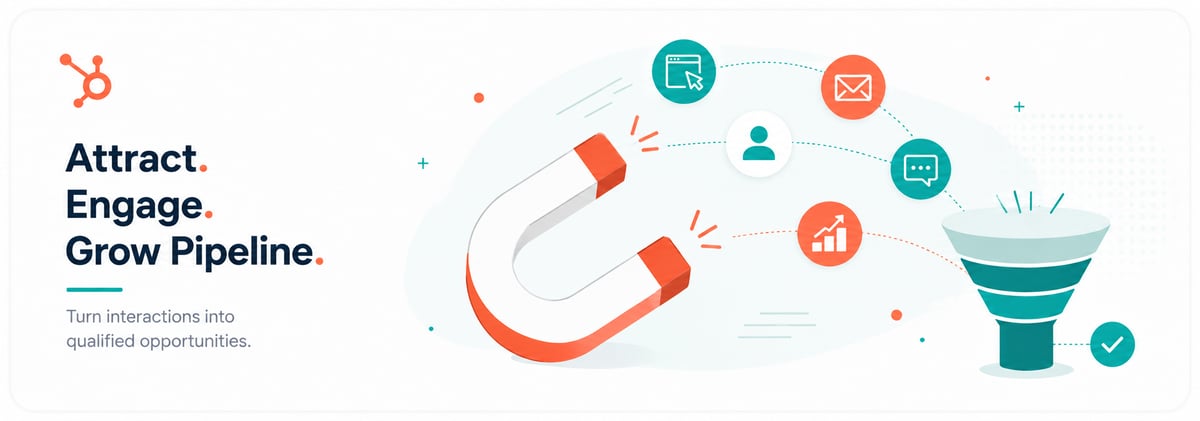
A demand generation engine is the connected system that turns marketing activity into measurable sales pipeline.
In HubSpot, this means connecting:
- website traffic
- content
- lead capture
- lifecycle stages
- CRM data
- sales engagement
- reporting
- automation
- pipeline attribution
Most businesses generate activity.
Fewer businesses generate consistent pipeline.
That gap is usually caused by disconnected systems, unclear qualification processes or weak conversion infrastructure.
Why Is Marketing Activity Not Turning Into Sales Pipeline?
The most common reason is poor system connection between marketing, website conversion and sales processes.
Many B2B companies:
- generate traffic
- publish content
- run paid campaigns
- collect leads
But they cannot clearly answer:
- which activity creates revenue
- which leads are commercially qualified
- where leads drop out
- why conversion rates remain low
- which campaigns influence pipeline
This usually creates tension between sales and marketing.
Marketing sees activity. Sales sees weak pipeline quality.
The problem is often not lead volume.
The problem is the revenue system behind the activity.
How Do You Build a Demand Generation Engine Using HubSpot?
You build it by connecting demand generation to CRM structure, lifecycle management and sales outcomes.
The process usually includes:
- defining the ideal customer profile (ICP)
- improving website conversion pathways
- structuring lifecycle stages
- implementing attribution tracking
- aligning sales qualification
- building nurture workflows
- creating reporting tied to revenue
Demand generation should not operate separately from the CRM.
HubSpot works best when marketing, sales and operations share the same commercial visibility.
What Should a Good HubSpot Demand Generation Setup Include?
A strong setup should create visibility from first website visit through to closed revenue.
Core components of a demand generation engine
|
Area |
What good looks like |
|
Website |
Clear conversion pathways and CTAs |
|
CRM |
Clean lead tracking and ownership |
|
Lifecycle stages |
Defined qualification rules |
|
Reporting |
Pipeline attribution visibility |
|
Sales process |
Fast lead follow-up |
|
Automation |
Nurture and routing support |
|
AI |
Insight and optimisation support |
|
Marketing |
Campaigns tied to pipeline outcomes |
Disconnected systems create disconnected reporting.
That is usually why businesses struggle to scale demand generation efficiently.
How Do You Improve Website Conversion in HubSpot?
Website conversion improves when the site is treated as part of the revenue system rather than a standalone marketing asset.
Most B2B website conversion problems come from:
- unclear messaging
- weak CTAs
- poor attribution setup
- disconnected CRM tracking
- too many conversion paths
- slow sales follow-up
- forms collecting poor-quality leads
- content not aligned to buying intent
Improving conversion is not only about design.
It is about commercial alignment between:
- website experience
- lead qualification
- sales process
- CRM visibility
What Causes Poor Lead Quality in HubSpot?
Poor lead quality usually comes from weak qualification systems rather than poor lead generation itself.
Common causes of low-quality leads
|
Problem |
Commercial impact |
|
Broad targeting |
Low conversion rates |
|
Weak forms |
Unqualified submissions |
|
No lifecycle rules |
Sales confusion |
|
Slow response times |
Lost opportunities |
|
Poor attribution |
Budget misallocation |
|
Disconnected campaigns |
Low sales relevance |
|
Generic content |
Weak buying intent |
|
CRM data issues |
Inaccurate reporting |
Many businesses focus on increasing lead volume before fixing qualification.
That often increases operational noise rather than pipeline.
How Important Are Lifecycle Stages for Demand Generation?
Lifecycle stages are one of the most important parts of a revenue growth system.
They define:
- who owns the lead
- when sales should engage
- how reporting works
- how automation behaves
- what counts as qualified demand
Without clear lifecycle stages:
- sales and marketing use different definitions
- reporting becomes inconsistent
- lead nurturing breaks down
- pipeline forecasting becomes unreliable
HubSpot can automate lifecycle management well, but only when the process itself is clearly defined.
How Should Sales and Marketing Work Together in HubSpot?
Sales and marketing should operate from shared commercial definitions and shared reporting.
That means agreeing:
- what counts as a qualified lead
- when handoff happens
- how follow-up works
- how attribution is measured
- what pipeline metrics matter
Signs alignment is weak
- sales ignores MQLs
- marketing optimises for lead volume only
- reporting is disputed
- CRM adoption is inconsistent
- follow-up times are slow
- pipeline attribution is unclear
A connected demand generation engine reduces these issues significantly.
How we can help
If marketing activity is generating leads but not reliable pipeline, the issue is usually deeper than campaign performance.
Imagine Growth’s Revenue System Growth service helps B2B companies connect:
- HubSpot
- website conversion
- lifecycle stages
- demand generation
- sales processes
- reporting
- AI optimisation
The goal is to improve pipeline quality, conversion and revenue visibility across the entire growth system.
Speak to us to learn more.

What Should You Fix First to Improve Pipeline Growth?
Most businesses should focus on operational clarity before scaling campaigns further.
Recommended priorities for revenue system growth
- ICP and targeting clarity
- Website conversion pathways
- Lifecycle stage definitions
- Lead routing and response times
- Attribution tracking
- CRM data quality
- Sales and marketing reporting alignment
- AI optimisation
Scaling traffic before fixing conversion and qualification usually creates more waste.
Practical Demand Generation Checklist
Website and Conversion
- Are CTAs aligned to buyer intent?
- Are forms capturing useful qualification data?
- Is attribution tracking accurate?
- Are landing pages conversion-focused?
CRM and Lifecycle Management
- Are lifecycle stages documented?
- Is ownership clear?
- Are leads routed automatically?
- Is follow-up measured?
Sales Alignment
- Do sales trust lead quality?
- Are qualification criteria agreed?
- Are response times tracked?
Reporting
- Can pipeline be tracked by source?
- Can marketing influence be measured?
- Is revenue attribution reliable?
AI and Optimisation
- Is CRM data clean enough for AI?
- Are workflows documented?
- Are insights actionable?
Common Demand Generation Mistakes in HubSpot
Prioritising lead volume over pipeline quality
More leads do not automatically create more revenue.
Treating the website separately from CRM strategy
Your website should support lifecycle progression and pipeline generation.
Running campaigns without attribution clarity
If attribution is unreliable, budget allocation becomes guesswork.
Building automation around unclear processes
Automation should support operational clarity, not compensate for missing strategy.
Ignoring sales response speed
Fast response times often improve conversion more than increasing lead volume.
When Should You Get Expert Help With Revenue System Growth?
You should consider expert support when:
- pipeline growth has stalled
- sales and marketing disagree on lead quality
- website traffic is increasing without revenue growth
- reporting cannot be trusted
- lifecycle stages are inconsistent
- attribution is unclear
- HubSpot feels operationally messy
- AI initiatives are limited by poor CRM structure
Revenue growth problems are often operational system problems disguised as marketing issues.
What Makes Revenue System Growth Different From Standard Marketing Support?
Traditional marketing support focuses on campaigns.
Revenue system growth focuses on the commercial infrastructure behind pipeline creation.
Standard Marketing vs Revenue System Growth
|
Standard Marketing Support |
Revenue System Growth |
|
Campaign execution |
Pipeline optimisation |
|
Lead generation |
Revenue generation |
|
Channel reporting |
Commercial visibility |
|
Marketing metrics |
Sales and revenue metrics |
|
Traffic growth |
Conversion and qualification |
|
Isolated activity |
Connected revenue systems |
The difference is whether activity creates measurable commercial outcomes.
FAQs About Demand Generation and HubSpot Revenue Growth
What is a demand generation engine in HubSpot?
It is a connected system linking website conversion, CRM management, lifecycle stages, sales engagement, reporting and marketing activity into one pipeline generation process.
Why are my HubSpot leads not converting into sales?
Common reasons include weak qualification, poor lifecycle structure, slow sales response, disconnected reporting and unclear targeting.
How do you improve website conversion in HubSpot?
Improve messaging, CTAs, attribution tracking, form quality, lifecycle progression and sales follow-up processes.
What causes poor lead quality in B2B marketing?
Broad targeting, weak qualification criteria, poor CRM structure and disconnected sales alignment are common causes.
How do you connect demand generation to revenue reporting?
Use lifecycle stages, attribution tracking, pipeline reporting and CRM-connected campaigns to measure commercial impact.
Can AI improve demand generation performance?
Yes, but only when CRM data, reporting and operational processes are structured properly.
What metrics matter most in a demand generation system?
Pipeline contribution, conversion rates, sales velocity, lead quality, attribution accuracy and revenue influence matter more than lead volume alone.
Summary
Most B2B companies do not have a lead generation problem.
They have a revenue system problem.
Imagine Growth’s Revenue System Growth service helps businesses improve:
- demand generation
- website conversion
- lead quality
- pipeline creation
- reporting visibility
- HubSpot performance
- AI-enabled optimisation
The result is a connected growth system designed to generate a measurable pipeline, not disconnected marketing activity.
If your business is producing marketing activity without consistent revenue impact, the underlying revenue system is usually the place to fix first.
Speak to use to get expert help.